 breast.oncosurgery@gmail.com
 +91 9871413426
 Home
Home Testimonials
 Blogs
Blogs Contact


Breast Cancer Treatment in 2026: What Has Changed Beyond Surgery and Chemotherapy?
- Blog
- Breast Cancer Treatment in 2026
Breast cancer treatment has changed significantly in recent years. While surgery and chemotherapy continue to play an important role in treating many patients, breast cancer care in 2026 is much more personalised than it was in the past. Doctors now have a better understanding of the biology of breast cancer and can use information such as hormone receptor status, HER2 status, genetic mutations, tumour characteristics and treatment response to develop a more individualised treatment plan.
For patients and families, this means that a breast cancer diagnosis does not automatically lead to the same treatment pathway for everyone. One patient may need surgery followed by hormone therapy, while another may receive chemotherapy, targeted therapy or immunotherapy before surgery. Some patients may benefit from newer antibody-drug conjugates or other precision medicines. The focus is increasingly on giving the right treatment to the right patient at the right time.
For anyone searching for an experienced Breast Cancer Doctor in Delhi, Breast Cancer Doctor in Gurgaon/Gurugram, or Breast Cancer Doctor in Haryana, understanding these advances can help in making informed decisions about treatment.
How Has Breast Cancer Treatment Changed in 2026?
The biggest change in breast cancer treatment is the move from a largely standardised approach to a more personalised one. In the past, treatment decisions were often driven primarily by the size of the tumour, whether lymph nodes were involved and the stage of the cancer. These factors remain extremely important, but doctors now also examine the biological characteristics of the tumour.
Breast cancer is not a single disease. It consists of different subtypes that behave differently and respond differently to treatment. Hormone receptor-positive breast cancer, HER2-positive breast cancer and triple-negative breast cancer can require very different treatment strategies.
Modern breast cancer treatment therefore begins with understanding what type of cancer a patient has. Tests for estrogen receptor, progesterone receptor and HER2 status are particularly important. Depending on the individual case, doctors may also recommend genetic testing or additional molecular and biomarker testing.
This information can help the oncology team decide whether surgery, chemotherapy, hormone therapy, targeted therapy, immunotherapy, radiation therapy or a combination of these treatments is most appropriate.
Surgery Is Still Important, But It Is No Longer the Whole Treatment
The development of newer treatments does not mean that surgery has become less important. For many patients with early-stage or operable breast cancer, surgery remains a critical part of treatment.
What has changed is the way surgery is integrated into the overall treatment plan. The decision is no longer simply about removing the tumour. Doctors consider the tumour's biology, size, location, lymph node status, genetic characteristics and response to any treatment given before surgery.
Depending on the patient's diagnosis, breast-conserving surgery or mastectomy may be considered. Lymph node assessment may also be required. In selected cases, reconstructive procedures can be performed as part of the overall surgical plan.
For patients considering Breast Cancer Surgery in Delhi, Breast Cancer Surgery in Gurgaon/Gurugram, or Breast Cancer Surgery in Haryana, it is important to understand that the operation is only one component of breast cancer treatment. The most appropriate surgical approach should be decided as part of a comprehensive treatment plan.
Treatment Before Surgery Is Becoming More Important
One of the major changes in modern breast cancer treatment is the increasing use of treatment before surgery, known as neoadjuvant therapy.
Depending on the subtype and stage of breast cancer, doctors may recommend chemotherapy, targeted therapy or immunotherapy before an operation. The purpose can be to shrink the tumour, treat microscopic cancer cells elsewhere in the body and assess how the cancer responds to treatment.
The response to treatment can provide valuable information. Some patients may have a very strong response, while others may have residual cancer at the time of surgery. This information can help doctors determine whether additional treatment is needed after surgery.
This approach has changed the traditional sequence of breast cancer care. Instead of automatically performing surgery first, doctors can sometimes use systemic treatment to attack the cancer before the operation.
Targeted Therapy Is Transforming Breast Cancer Care
Targeted therapy is one of the most important advances in breast cancer treatment. Traditional chemotherapy works by attacking rapidly dividing cells, while targeted therapies are designed to interfere with specific molecules or pathways that help cancer cells grow and survive.
HER2-positive breast cancer is one of the clearest examples of how targeted treatment has transformed patient care. HER2-targeted medicines have significantly improved outcomes for patients whose cancers have this biological characteristic.
Medicines targeting HER2 include trastuzumab and pertuzumab, while newer treatments such as trastuzumab deruxtecan and tucatinib have expanded treatment options in selected patients. The availability of these treatments means that HER2-positive breast cancer can be approached with therapies specifically designed to target the biology of the tumour.
The understanding of HER2 itself has also become more sophisticated. Researchers and clinicians now recognise categories such as HER2-low and HER2-ultralow disease, which has opened opportunities for certain newer treatments in selected patients.
This is an important example of why breast cancer treatment today cannot be determined by stage alone. The biological characteristics of the tumour can influence the treatment strategy.
Antibody-Drug Conjugates Are Changing the Treatment Landscape
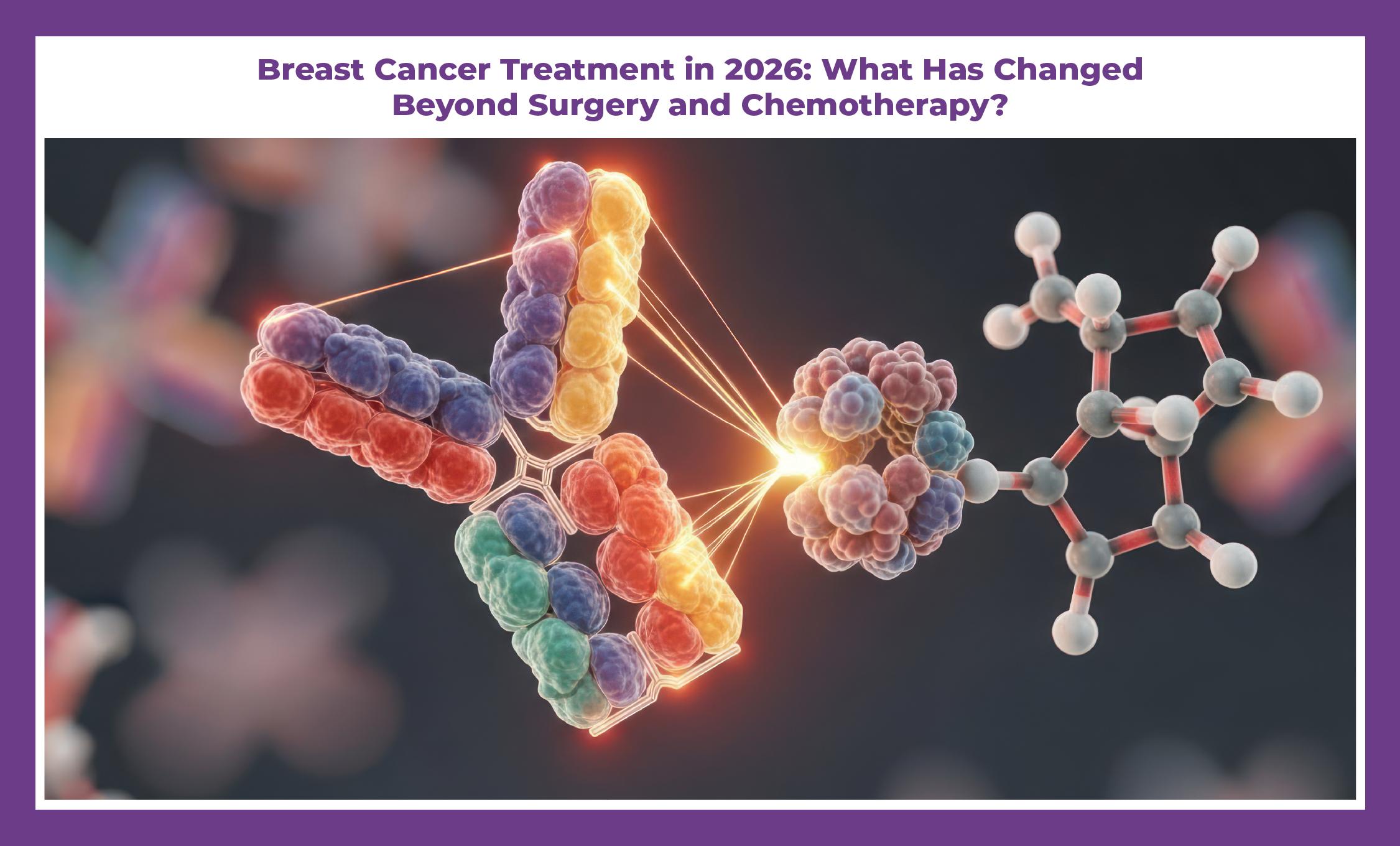
Another important development in breast cancer treatment is the increasing use of antibody-drug conjugates, often called ADCs.
An antibody-drug conjugate combines an antibody that recognises a specific target on cancer cells with a powerful anti-cancer drug. The antibody helps deliver the drug to cells carrying the target, creating a more targeted approach to treatment.
Importantly, antibody-drug conjugates are no longer viewed only as treatments used very late in the course of advanced cancer. Research and regulatory developments are moving some of these treatments into earlier stages of breast cancer for selected patients.
This represents an important shift in the treatment philosophy: newer targeted medicines may be used earlier when doctors believe they can improve the chance of controlling or eliminating the disease.
Immunotherapy Has Become an Important Option for Selected Patients
Immunotherapy is another major development in breast cancer care. Unlike conventional chemotherapy, which directly attacks rapidly dividing cells, immunotherapy works by helping the immune system recognise and attack cancer cells.
Its role is particularly important in selected patients with triple-negative breast cancer.
Triple-negative breast cancer does not have estrogen receptors, progesterone receptors or high levels of HER2, which means that some commonly used targeted and hormone treatments are not effective. For selected patients, immunotherapy combined with chemotherapy can provide another treatment strategy.
In certain early-stage triple-negative breast cancers, treatment may begin before surgery and continue after surgery depending on the patient's individual circumstances.
However, immunotherapy is not appropriate for every breast cancer patient. The decision depends on factors such as cancer subtype, stage, biomarkers, previous treatment and the patient's overall health.
Hormone Therapy Has Become More Advanced
Hormone receptor-positive breast cancer is one of the most common types of breast cancer. Endocrine therapy remains an important part of treatment, but modern hormone-based treatment is increasingly combined with targeted medicines.
Other targeted treatments may also be considered when specific molecular alterations are identified.
This means that even within hormone receptor-positive breast cancer, treatment can vary considerably between patients. A doctor may consider the patient's stage, menopausal status, tumour biology, recurrence risk, previous treatment and molecular findings before recommending a treatment strategy.
Genetic Testing Can Influence Treatment Decisions
Genetic testing has also become increasingly relevant in breast cancer management. Certain inherited genetic mutations can increase the risk of breast and other cancers. BRCA1 and BRCA2 are among the best-known examples.
Identifying an inherited mutation may have implications not only for treatment but also for understanding future cancer risk and, in some circumstances, assessing cancer risk among family members.
Certain targeted medicines, including PARP inhibitors, can be useful in selected patients with specific genetic characteristics.
However, genetic testing is not automatically necessary for every breast cancer patient. A specialist may recommend testing based on factors such as age at diagnosis, family history, tumour characteristics and other clinical findings.
Triple-Negative Breast Cancer Treatment Is Evolving
Triple-negative breast cancer has historically been one of the more challenging breast cancer subtypes because it lacks the three commonly targeted characteristics of estrogen receptor, progesterone receptor and HER2.
Chemotherapy remains an important treatment for many patients with triple-negative disease. However, the treatment landscape has expanded with the introduction of immunotherapy and antibody-drug conjugates.
Research is also continuing into new targeted treatments and combinations that may improve outcomes for patients with advanced or treatment-resistant disease.
Because triple-negative breast cancer can behave differently from other breast cancer subtypes, accurate diagnosis and careful treatment planning are particularly important.
Breast Cancer Treatment Is Becoming More Response-Based
No
Another major change is that doctors are increasingly interested in how a tumour responds to treatment.
When treatment is given before surgery, the surgical specimen can provide important information about whether the cancer has responded completely or whether residual invasive cancer remains.
This information can influence decisions about treatment after surgery.
As a result, breast cancer treatment is becoming a continuous process of assessment and adjustment rather than a fixed sequence of treatments decided at the beginning.
The treatment plan can evolve according to how the cancer behaves.
Radiation Therapy Is Becoming More Precise
Radiation therapy remains an important treatment for selected breast cancer patients, particularly after certain types of surgery or when there are specific risk factors.
Modern radiation techniques have improved the ability to deliver radiation accurately while limiting exposure to surrounding healthy tissues.
Whether radiation is needed depends on factors such as tumour size, lymph node involvement, type of surgery, tumour biology and other individual characteristics.
Therefore, radiation is not automatically required for every breast cancer patient. The decision should be made after considering the complete clinical picture.
Artificial Intelligence Is Also Entering Breast Cancer Care
Artificial intelligence is increasingly being studied and used as a support tool in breast cancer diagnosis and treatment. AI-based technologies can assist with medical imaging, mammography analysis, pathology assessment, risk prediction and clinical decision support.
AI may help doctors identify subtle patterns in medical images or pathology specimens that could otherwise be difficult to detect. Researchers are also exploring how artificial intelligence can combine imaging, pathology and molecular information to predict treatment response and recurrence risk.
However, AI does not replace a breast cancer specialist. A diagnosis and treatment plan require clinical judgement and consideration of the patient's complete medical history, examination findings, imaging, pathology and personal preferences.
The likely future of AI in breast cancer care is therefore collaboration between advanced technology and experienced medical teams.
Is Chemotherapy Still Needed for Breast Cancer in 2026?
Yes, chemotherapy continues to be an important treatment for many breast cancer patients. The difference is that chemotherapy is increasingly used selectively rather than automatically.
Some patients have cancers where chemotherapy provides substantial benefit, while others may have biological characteristics or genomic risk profiles suggesting that chemotherapy may offer limited additional benefit.
The decision depends on the patient's cancer subtype, stage, recurrence risk, biomarkers, age, overall health and other factors.
The goal of modern oncology is not to give every possible treatment. It is to identify the treatment that provides meaningful benefit while avoiding unnecessary side effects whenever possible.
Does Every Breast Cancer Patient Need Surgery?
Not necessarily in the same way, and the timing of surgery can vary.
For many patients with localised breast cancer, surgery remains an essential part of treatment. However, the type and timing of surgery depend on the individual case.
Some patients may undergo surgery first. Others may receive systemic therapy before surgery. In selected advanced cases, treatment may focus primarily on controlling disease throughout the body, with surgery considered only in specific circumstances.
Therefore, there is no single breast cancer treatment pathway that applies to everyone.
Why a Multidisciplinary Breast Cancer Team Matters?
Modern breast cancer treatment often involves several specialists. A breast surgeon may work alongside a medical oncologist, radiation oncologist, radiologist, pathologist, genetic counsellor and other healthcare professionals.
This multidisciplinary approach allows the treatment team to consider the cancer from different perspectives.
For example, a surgeon may determine whether breast-conserving surgery is technically possible, while the medical oncologist considers systemic therapy and the radiation oncologist evaluates whether radiation would be beneficial.
For patients, this can provide a more comprehensive treatment strategy rather than isolated decisions about individual treatments.
Choosing a Breast Cancer Specialist in Delhi, Gurgaon or Haryana
If you have been diagnosed with breast cancer, choosing the right specialist is an important decision. Patients searching for a Best Breast Cancer Surgeon in Delhi, Breast Cancer Doctor in Delhi, Breast Cancer Doctor in Gurgaon/Gurugram, or Breast Cancer Doctor in Haryana should look beyond the procedure itself.
A consultation should include an understanding of the cancer subtype, stage, pathology, biomarkers and available treatment options. The specialist should also explain whether surgery should be performed first or whether treatment before surgery may be more appropriate.
Patients looking for Breast Cancer Surgery in Delhi, Breast Cancer Surgery in Gurgaon/Gurugram, or Breast Cancer Surgery in Haryana should also discuss the expected role of surgery within the larger treatment plan.
Dr Deepak Jha and Individualised Breast Cancer Care
Dr Deepak Jha is an experienced breast cancer surgeon who focuses on the surgical management and comprehensive planning of breast cancer treatment. With modern breast cancer care becoming increasingly personalised, the role of an experienced breast surgeon extends beyond performing an operation.
The treatment plan may involve surgery, systemic therapy, radiation therapy, targeted treatment, hormone therapy or immunotherapy depending on the patient's diagnosis.
For patients looking for a Best Breast Cancer Surgeon in Gurgaon/Gurugram, Breast Cancer Surgeon in Haryana, or Breast Cancer Doctor in Delhi, a detailed consultation with Dr Deepak Jha can help patients understand their diagnosis and the treatment options available for their specific situation.
What Should You Ask Your Breast Cancer Doctor?
Before starting treatment, patients should feel comfortable asking their doctor what type of breast cancer they have, what their ER, PR and HER2 results show, whether additional biomarker or genetic testing is required and whether treatment should begin before surgery.
It is also reasonable to ask whether chemotherapy, targeted therapy, immunotherapy, hormone therapy or radiation therapy is likely to be useful. Patients can also ask what type of surgery is recommended, whether breast conservation is possible and how the treatment plan may change depending on their response.
Understanding these questions can help patients participate more confidently in treatment decisions.
Breast Cancer Treatment in 2026 Is More Personalised Than Ever
Breast cancer treatment in 2026 has moved well beyond the traditional concept of surgery and chemotherapy. Surgery remains extremely important for many patients, but it is now integrated with a much broader range of treatment options.
Targeted therapies, immunotherapy, antibody-drug conjugates, endocrine therapies, genetic testing and increasingly sophisticated biomarker analysis are changing the way breast cancer is treated. Treatment before surgery is becoming increasingly important for selected patients, while response to therapy can help guide what happens next.
The most important message for patients is that breast cancer is not one disease and treatment should not be one-size-fits-all.
Your treatment plan should be based on the type and stage of your cancer, its biological characteristics, your overall health and your individual treatment goals.
If you or a loved one has been diagnosed with breast cancer and are looking for an experienced Breast Cancer Doctor in Delhi, Breast Cancer Doctor in Gurgaon/Gurugram, Breast Cancer Doctor in Haryana, Best Breast Cancer Surgeon in Delhi, or Best Breast Cancer Surgeon in Gurgaon/Gurugram, seeking a detailed specialist consultation can help you understand your treatment options and make an informed decision.
When it comes to breast cancer, the goal is not simply to treat the cancer.
The goal is to choose the most appropriate treatment for the individual patient while achieving the best possible cancer control and quality of life.