 breast.oncosurgery@gmail.com
 +91 9871413426
 Home
 Testimonials
 Blogs
 Contact



Your Biopsy Says Breast Cancer
- Blog
- Your Biopsy Says Breast Cancer
Getting the words “breast cancer” on a biopsy report can feel overwhelming. You may suddenly have questions about treatment, surgery, chemotherapy, whether the cancer has spread, and what you should do next.
The important thing to understand is that a breast biopsy is not the end of the diagnostic process—it is often the point where doctors get the information needed to plan the next steps.
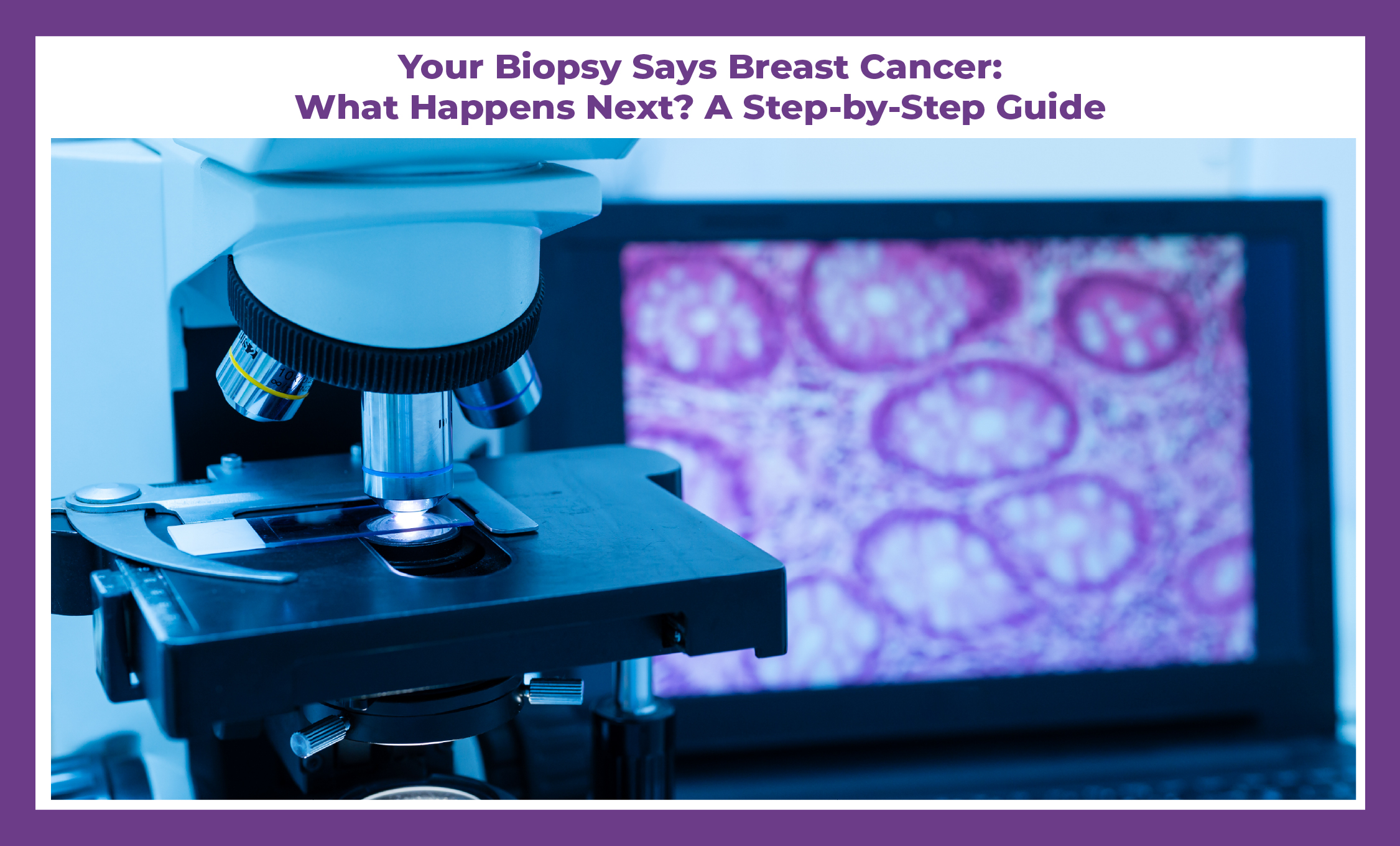
A biopsy sample is examined by a pathologist, who looks at the cells under a microscope and prepares a pathology report. If breast cancer is identified, additional information such as the cancer type, grade, hormone receptor status and HER2 status can help doctors understand the cancer and plan treatment.
So, what actually happens after a breast biopsy confirms cancer?
Let’s go through it step by step.
Step 1: First, Understand What Your Biopsy Report Says
Before thinking about surgery or chemotherapy, the first step is understanding the pathology report.
A breast biopsy can tell doctors whether the abnormal area is cancerous and, in many cases, provide important information about the type of cancer.
Your report may contain terms such as:
- Invasive breast cancer
- Ductal carcinoma
- Invasive lobular carcinoma
- Ductal carcinoma in situ (DCIS)
- Tumour grade
- Estrogen receptor (ER)
- Progesterone receptor (PR)
- HER2
- Ki-67
- Lymphovascular invasion
These terms can look frightening when you see them for the first time. However, each one answers a different question about the cancer.
For example, ER and PR tests show whether the cancer cells have hormone receptors, while HER2 testing looks for excess protein or gene activity. These results can influence which treatments may be appropriate.
Don't try to interpret the entire report yourself.
Instead, take the complete report to a breast cancer specialist and ask them to explain what each important finding means for your particular situation.
Step 2: Find Out What Type of Breast Cancer You Have
Not every breast cancer behaves in exactly the same way.
One of the first questions after a positive biopsy is:
“What type of breast cancer is this?”
Breast cancer can begin in different parts of the breast, including the milk ducts or lobules.
Some cancers are non-invasive, meaning abnormal cells have not invaded deeper breast tissue. DCIS is an example.
Other cancers are invasive, meaning cancer cells have moved beyond the original lining and into surrounding breast tissue.
This distinction matters because treatment planning depends on the specific characteristics of the cancer.
It is therefore not enough to simply know:
“My biopsy is positive.”
You need to understand what exactly the biopsy has shown.
Step 3: Understand Your ER, PR and HER2 Results
You may hear your doctor talk about breast cancer biomarkers.
These tests are important because they can provide information about how the cancer behaves and which medicines may be useful.
ER and PR: ER stands for estrogen receptor, while PR stands for progesterone receptor. If breast cancer cells contain these receptors, the cancer may be described as hormone receptor-positive. Hormone receptor status can influence whether hormonal treatment is included in the treatment plan.
HER2: HER2 is another important biomarker. HER2 testing can help identify cancers that may benefit from HER2-targeted treatment. HER2 results can include categories such as 0, 1+, 2+ or 3+ on immunohistochemistry, with additional testing sometimes required for certain results
Why does this matter?
Two people can both have breast cancer but receive different treatment plans because their tumour characteristics are different.
That is why treatment should not be decided simply based on the fact that the biopsy is positive.
Step 4: Your Doctor May Recommend Additional Tests
A positive biopsy does not always mean you immediately go into surgery.
Your doctor first needs to understand the complete picture
Depending on your situation, additional imaging or investigations may be recommended to determine the size and location of the tumour and whether there is evidence of spread.
Staging is the process used to determine how extensive the cancer is. It considers factors such as the tumour, nearby lymph nodes and whether cancer has spread to distant parts of the body.
The tests recommended can vary from one patient to another.
Your doctor may consider information from:
- Mammography
- Breast ultrasound
- Breast MRI in selected situations
- Lymph-node evaluation
- Blood test
- Other imaging when clinically indicated
- Additional pathology or biomarker testing
This does not mean that every person diagnosed with breast cancer needs every available test.
Your doctor decides what is appropriate based on your biopsy, examination, imaging and overall clinical picture.
Step 5: Find Out Whether the Lymph Nodes Need Evaluation
The lymph nodes under the arm, known as axillary lymph nodes, are often considered when breast cancer is being staged.
Doctors may evaluate lymph nodes through physical examination, imaging or procedures such as a sentinel lymph node biopsy, depending on the circumstances.
The sentinel lymph nodes are the first lymph nodes to which a breast tumour is likely to drain.
If cancer cells are found in these nodes, the information can contribute to staging and treatment planning.
However, hearing the words “lymph node” does not automatically mean that cancer has spread.
This is an important distinction.
Your doctor needs to interpret lymph-node findings together with your imaging, biopsy and other clinical information.
Step 6: Determine the Stage of Breast Cancer
One of the biggest questions patients have after a positive biopsy is:
“What stage is my breast cancer?”
The stage describes how extensive the cancer is.
Breast cancer staging takes into account several factors, including tumour size, lymph-node involvement, distant spread, tumour grade and certain biological characteristics.
You may hear terms such as:
- Stage 0
- Stage I
- Stage II
- Stage III
- Stage IV
But stage alone does not tell the complete story.
The biology of the tumour also matters.
For example, hormone receptor status and HER2 status can influence treatment decisions.
This is why two people with the same stage may not necessarily receive identical treatment.
Step 7: Meet the Breast Cancer Treatment Team
Once the diagnostic information is available, you may meet one or more specialists.
Your treatment team may include a:
- Breast surgeon
- Medical oncologist
- Radiation oncologist
- Radiologist
- Pathologist
- Specialist nurse or other healthcare professionals
The exact team depends on your diagnosis and treatment requirements.
A breast surgeon focuses on surgical management of breast cancer and can discuss whether breast-conserving surgery, mastectomy or another surgical approach may be appropriate.
A medical oncologist may discuss medicines such as chemotherapy, hormonal therapy, targeted therapy or immunotherapy when appropriate.
A radiation oncologist evaluates whether radiation therapy should be part of treatment.
Breast cancer treatment is often multidisciplinary because surgery, medicines and radiation may each have a role depending on the individual cancer.
Step 8: Does a Positive Biopsy Mean You Need Surgery Immediately?
Not necessarily.
This is one of the most common misconceptions after a breast cancer diagnosis.
Some patients may undergo surgery first.
For others, treatment such as chemotherapy, targeted therapy or other systemic treatment may be recommended before surgery
This is called neoadjuvant treatment.
The sequence depends on factors such as:
- Tumour size
- Cancer subtype
- HER2 status
- Hormone receptor status
- Lymph-node involvement
- Overall stage
- Other individual factors
NCI notes that treatment planning can consider stage, grade and molecular characteristics such as ER, PR and HER2 status.
Therefore, don't assume that:
Step 11: Understand That Chemotherapy Is Not Automatically Required
Another common fear after a breast cancer diagnosis is:
“Will I definitely need chemotherapy?”
The answer is not necessarily.
Breast cancer treatment can include local treatments such as surgery and radiation and systemic treatments such as chemotherapy, hormone therapy, targeted therapy and immunotherapy.
The decision depends on the individual cancer.
Some patients may need chemotherapy.
Others may receive hormonal therapy, targeted therapy, radiation, surgery or a combination of treatments.
In selected situations, additional genomic or molecular tests may also help doctors determine whether certain treatments are likely to be useful.
So don't assume that a breast cancer diagnosis automatically means chemotherapy.
Step 12: Get Your Questions Ready before Your Appointment
After receiving a positive biopsy report, it is easy to forget important questions during the consultation.
Take your pathology report, imaging reports and previous medical records with you.
You may want to ask:
- What type of breast cancer do I have?
- Is it invasive or non-invasive?
- What is the tumour grade?
- What are my ER and PR results?
- What is my HER2 status?
- What stage is my cancer?
- Do my lymph nodes need further evaluation?
- Do I need additional imaging or tests?
- Do I need surgery first or treatment before surgery?
- What surgical options are appropriate for me?
- Will I need chemotherapy, radiation, hormone therapy or targeted treatment?
- Should I consider a second opinion?
Having these questions written down can make the consultation easier and help you understand the treatment plan.
What If the Biopsy Result Is Not Clear?
Sometimes a biopsy does not provide a definitive answer.
This can happen when the tissue sample does not adequately explain the abnormality or when the pathology findings and imaging findings do not match.
In such situations, your doctor may recommend additional testing, another biopsy or a different type of biopsy.
The American Cancer Society notes that an inconclusive biopsy may require repeat biopsy or additional testing depending on the situation.
An unclear result does not automatically mean cancer.
It means more information may be needed before a diagnosis can be established.
What If the Biopsy Is Benign?
A breast biopsy does not always diagnose cancer.
Many breast abnormalities are benign.
If no cancer is found, your doctor will consider the biopsy result alongside the mammogram, ultrasound or other imaging findings.
Sometimes routine follow-up is all that is needed.
In other cases, additional investigation may be recommended if the pathology result does not adequately explain the imaging abnormality.
The important point is that a biopsy result should always be interpreted in the context of the complete clinical picture
What Happens After the Treatment Plan Is Decided?
Once your doctors have reviewed the biopsy, imaging, biomarkers and staging information, they can discuss your treatment plan.
Your treatment may involve one or more approaches, such as:
- Surgery - to remove the tumour
- Radiation therapy - to treat the breast or relevant areas when indicated.
- Chemotherapy - systemic treatment that can target cancer cells throughout the body.
- Hormone therapy - used for appropriate hormone receptor-positive cancers.
- Targeted therapy - medicines designed to target specific characteristics of cancer cells.
- Immunotherapy - used for selected breast cancer situations.
Not every patient needs all of these treatments.
The purpose of detailed testing after biopsy is precisely to avoid treating every breast cancer in the same way.
When Should You See a Breast Cancer Specialist?
If your biopsy has confirmed breast cancer, consider arranging a consultation with a doctor who regularly manages breast cancer.
A specialist can review your pathology report and imaging together rather than looking at the biopsy result in isolation.
For patients looking for breast cancer care in Delhi-NCR, searches may include Breast Cancer Doctor in Delhi, Breast Cancer Doctor in Gurgaon/Gurugram, or Breast Cancer Doctor in Haryana.
If surgery is being considered, patients may also search for a Best Breast Cancer Surgeon in Delhi, Best Breast Cancer Surgeon in Gurgaon/Gurugram, or Breast Cancer Surgeon in Haryan
Dr. Deepak Jha is a breast surgeon in Delhi and can evaluate the diagnosis, discuss surgical options and help patients understand where surgery fits into their overall breast cancer treatment plan.
Patients considering Breast Cancer Surgery in Delhi, Breast Cancer Surgery in Gurgaon/Gurugram, or Breast Cancer Surgery in Haryana can bring their biopsy and imaging reports to a specialist consultation for an individualized discussion.
Don't Let the Biopsy Report Become Your Treatment Plan
A pathology report contains important information, but it is only one part of the overall decision-making process.
After a breast cancer biopsy, the next steps usually involve understanding the pathology, confirming the tumour characteristics, completing appropriate staging, evaluating lymph nodes when necessary and discussing treatment options with the appropriate specialists.
You may have many questions at this stage.
That is completely understandable.
Instead of trying to interpret every medical term online, take your reports to a qualified breast cancer specialist and ask what they mean in your specific situation.
The right treatment plan depends on the individual patient—not just the word “cancer” on a biopsy report.
If you have recently received a breast cancer biopsy result and are looking for guidance on diagnosis, staging, breast cancer surgery or the next stage of treatment, a consultation with Dr. Deepak Jha can help you understand your reports and discuss the appropriate surgical options for your condition.
Subscribe Newsletter
Get all the information, latest updates, and articles delivered directly in your inbox